

A Health Care Marketer’s Roadmap: Replacing AI Fragmentation with Clear Direction
How Northwell Health and Children’s Wisconsin replace random acts of AI with a strategy for sustainable adoption.
// By Wendy Margolin //
 Deciding which AI tools to use and how to deploy them effectively can feel like assembling IKEA furniture. It’s supposed to be easy, functional, and improve your experience, but staring at dozens of pieces and instructions is enough to make you want to call a handyman.
Health care marketers face a similar challenge with AI. New tools and use cases arrive constantly, each promising greater efficiency, personalization, or productivity. But experimenting with the latest technology may not translate into meaningful progress for your organization.
During eHealthcare Strategy & Trends’ webinar, Stop Chasing AI “Shoulds”: A Focus-First Approach for Health System Marketers, leaders from Unlock Health, Northwell Health, and Children’s Wisconsin shared tips for navigating beyond fragmented AI testing toward AI systems that work for your specific marketing organization. The webinar was part of eHST’s June virtual summit, AI in Healthcare Marketing Week.

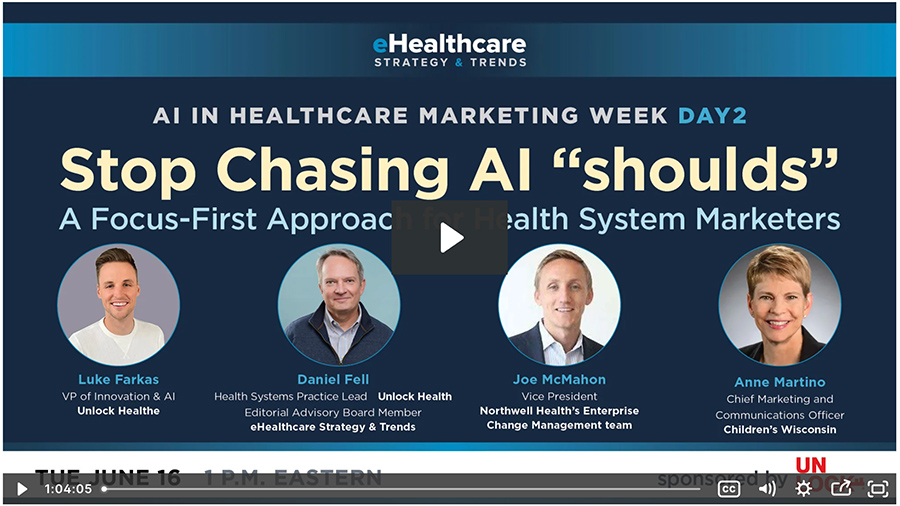
Left to right: Luke Farkas, vice president, innovation, Unlock Health; Daniel Fell, health systems practice lead, Unlock Health; Joe McMahon, vice president, Northwell Health’s enterprise change management team; Anne Martino, chief marketing and communications officer, Children’s Wisconsin
“Working in health care marketing over the last few years means being a full-time marketer and also a part-time AI trends tracker,” says Luke Farkas, vice president of innovation and AI at Unlock Health.
Here, the panelists discuss how to manage change brought about by AI, share a framework for understanding an organization’s starting point, and explain how to avoid one-off AI successes that seem like innovation but don’t create lasting impact.
The key to successfully integrating AI tools to advance your health care marketing and overall organizational goals, Farkas notes, is understanding how your team manages change in general.
“How do we take the experiments we’re doing and actually make them broadly applicable so that people use them consistently and that we can point to and measure and have success with? That often has more to do with how you manage change in your organization than the actual AI tool.”
Health Care Industry Remains Cautious About AI Adoption
The challenge with AI is creating room for experimentation without allowing experimentation itself to become the strategy.
Anne Martino is chief marketing and communications officer at Children’s Wisconsin and former chief marketing officer at Endeavor Health in the Chicago area. Endeavor uses Gemini as the baseline enterprise AI solution, and Children’s Wisconsin uses Copilot, a more conservative tool. In either case, Martino says, “There’s a lot of consistency around getting it right in this very uncomfortable position of not knowing where this is going or exactly how it will work.”
Testing and learning can help organizations move through the uncertainty and succeed. However, they should beware of a culture of “random acts of AI” where pockets of innovation and cool use cases occur within departments without a clear path for turning them into sustained or repeatable organizational success.
|
Click here to watch the full webinar
|
Marketers Lead the Way
In many administrative areas, and especially in AI use, Martino sees marketers playing an important role in AI adoption because they already operate across functions and communicate organizational change to multiple audiences. “Not only do we have to communicate everything, but we also need to be the leaders in understanding what it is and how it works and what’s needed to help everybody,” she says.
Northwell Health’s Joe McMahon says, “More than with any other technology, starting with strategy, the direction your organization is going, and your priorities can help you make decisions around AI.”
Custom AI Tool Protects Security, Connects Staff
Some large health systems address AI privacy concerns by building a proprietary tool. At Northwell Health, AI has transitioned from standalone experimental tools to system-wide infrastructure for completing work and solving everyday organizational problems.
Northwell deployed an internal tool called AI Hub a few years ago that combines several models into a custom tool that any team member in the organization can use. According to McMahon, more than half of Northwell employees access the hub and use it.
Beyond security compliance, the custom tool also provides a system-wide shared hub for all things AI. Education and resources are embedded directly into the tool staff uses daily. “It’s enabling us to meet the needs of the organization in a way that feels authentic to folks,” says McMahon.
For example, Northwell recently went live on Epic as its new electronic health record, leveraging the existing AI hub platform to create quick, seamless access to questions and resources specific to using Epic.
“This AI feels specific to who we are as an organization by meeting people where they are and meeting their needs, whether they’re operational questions or otherwise,” says McMahon.
The more employees use the AI hub, the more user-friendly it becomes. Staff members have created tasks that their teams can access, including guardrails around who can use them. In one example, internally developed tools helped leaders process the information from an employee experience survey and develop action plans.
Have Open and Transparent Discussions Around AI Adoption
Technology is only as useful as the person deploying it, and determining where AI is right for your organization is essential, says McMahon. This requires being as transparent as possible about system-level decisions. People are more likely to adopt new processes or ways of working if they understand why they’re investing their time to learn how to use AI tools. “Leading with the strategy and being intentional about transparency in your decision-making as an organization is paramount,” says McMahon.
Enabling more people to share ideas and drive innovation helps ensure team members, clinicians, administrators, and operational staff are on board.
One of Martino’s first initiatives when she began at Children’s Wisconsin was to survey her team on AI readiness. The results showed both interest and significant hesitation:
- 61 percent consider themselves a beginner
- 30 percent are using AI daily for work
- 58 percent of the sentiment around AI is negative
- 65 percent are concerned about losing humanity in their work
“As the technology evolves, there’s a human aspect of adopting, embracing, and feeling comfortable with it,” says Martino.
Tapping into innovation and idea generation requires removing barriers and addressing people’s concerns about AI. “As a proponent of the technology, I have to find a way to work through it and understand where my team is now and how we can educate them about this change that is coming,” says Martino.
McMahon recommends the following:
- Clarifying the purpose of any AI tools or workflows
- Clearly communicating the purpose
- Ongoing listening
- Collecting adoption metrics
C-Suite Support Turns Pilots into Organizational Change
Even the strongest marketing or IT team can only take AI adoption so far without executive support. “While IT is critically important to driving the direction you’re going with any technology, unless you have your C-suite on board, you’ll get some small wins, but it won’t move the organization,” says McMahon.
Executive alignment becomes especially important as organizations move from isolated experiments to AI tools and workflows that cross departments, require governance or change how employees work.
Once leaders align on the need to move forward, Unlock Health offers a framework for how organizations can move forward with strategic AI use.
An AI Adoption Roadmap
Farkas explains an AI adoption framework focused on two dimensions:
- Archetype: How your organization naturally approaches innovation and change
- Fluency: How effectively your organization currently uses AI
Rather than expecting a health system to change its organizational DNA, the framework encourages leaders to understand it and use it as a starting point for AI adoption.
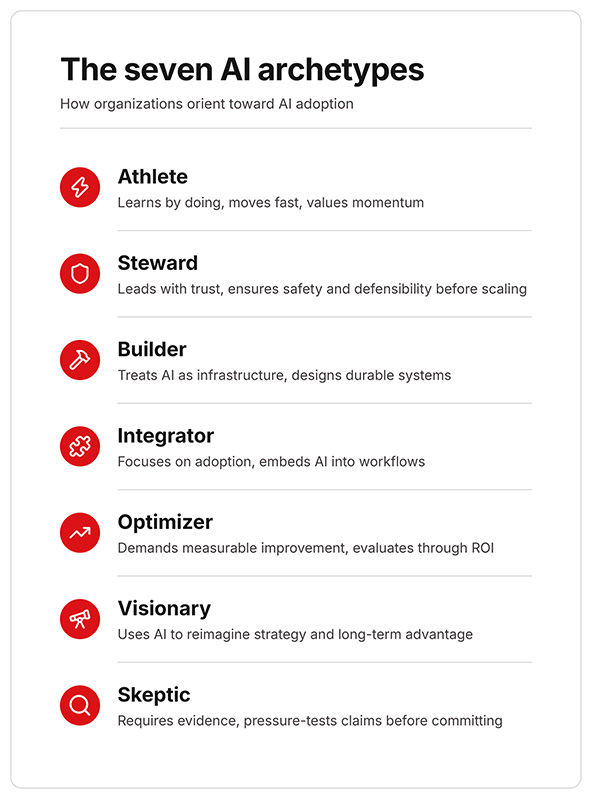
Understanding which AI archetype describes an organization helps its leaders craft the right approach to AI.
The second dimension, fluency, describes how far an organization has progressed in putting AI to work. The goal, says Farkas, is to progress from becoming ad-hoc experiments to embedding AI more broadly into the organization.
Farkas describes five levels of AI fluency he typically sees:
- Getting oriented
- Experimenting with technology
- Translating AI into operational change
- Institutionalizing so AI is embedded into workflows at scale
- Using AI in a way that is truly differentiated and creates competitive advantage
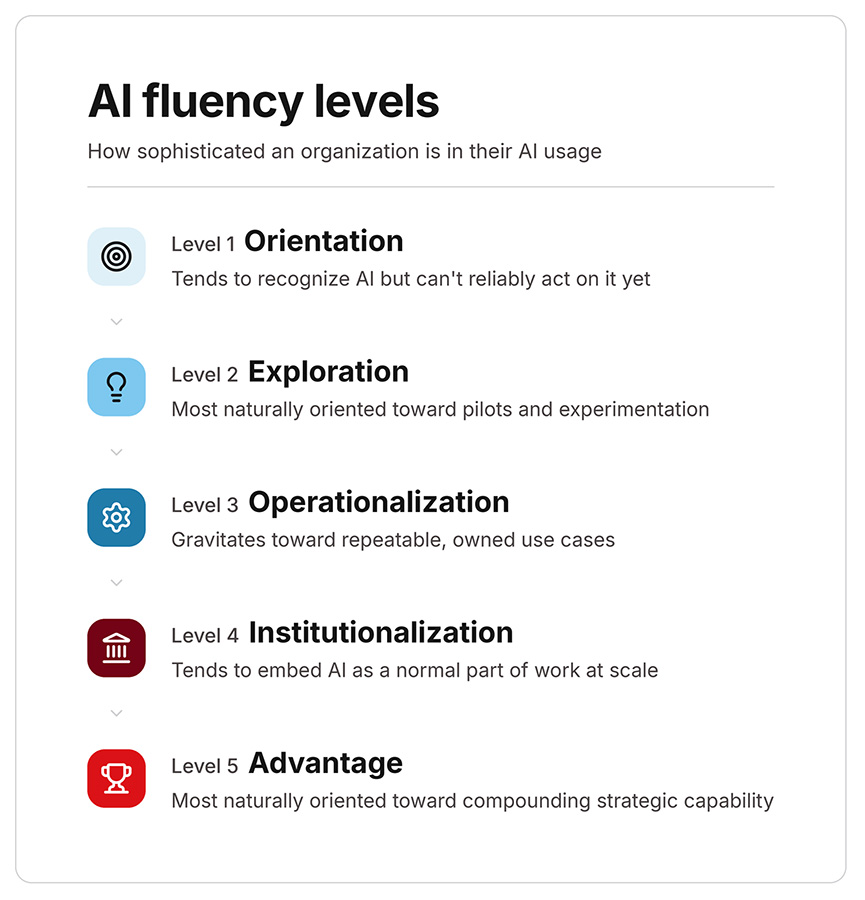
This chart illustrates levels of AI fluency from an enterprise point of view, helping organizations identify their starting point.
Putting archetype and fluency together creates a customized AI roadmap, says Farkas. Instead of prescribing the same AI maturity model for every health system, the framework asks two practical questions:
- What comes naturally to us?
- Where are we today?
Health systems at one fluency level may be aligned with different archetypes and need different strategies to advance.
- “Athlete” organization: Learns by experimenting and may need to narrow a large collection of pilots to the most promising use cases and operationalize them.
- “Skeptic” organization: May need to create evaluation processes to provide sufficient evidence without making it too difficult to test lower-risk applications and keeping promising ideas from ever getting off the ground.
- A “Visionary” organization: May readily see how AI could fundamentally change strategy or competitive positioning, rather than simply make existing processes more efficient.
From there, the goal is to move to the next level of AI fluency while recognizing strengths and blind spots tied to the organization’s existing culture.
The framework can help leaders identify what they need to make progress. A visionary organization may need people who can connect “what’s possible in three years” with “what should we be doing on Thursday?”
“A visionary organization has in spades vision, ambition, alignment, but where that might leave them exposed is in the actual execution,” says Farkas.
The tool helps identify organizational capabilities, guardrails, and next steps required to turn AI ambition into operational progress. What’s particularly helpful, says Farkas, is that “progress is very possible regardless of the archetype that you are as long as we’re honest about where we’re starting from.”
The final message for health care marketing leaders is not to stop experimenting with AI, but to do so while ensuring experimentation leads to progress.
5 Steps to Help Replace Random Acts of AI with Strategy
- Start with your organizational priority, not an AI tool. Identify the business, marketing, patient, or workforce problem you’re trying to solve before choosing technology.
- Understand your organization’s approach to change. Consider how your health system typically approaches innovation, uncertainty, and risk so you build on your strengths and address blind spots.
- Assess where AI adoption stands today. Take inventory of your existing experiments, tools, and workflows to distinguish isolated AI applications that already create repeatable value.
- Bring employees into the process. Communicate why AI is being adopted, listen to concerns, and create opportunities for employees to help identify useful applications.
- Build a path from testing to scaling. Establish governance, ownership, and adoption measures so successful AI use cases can move beyond individual teams and become part of everyday operations.
As owner of Sparkr Marketing, Wendy Margolin helps busy health care marketing communications teams create more content. She’s on a mission to build a better medical web, one article at a time. Her favorite form of content is hospital brand journalism, which ties together her 25-year career in journalism, marketing, and health care.