
Social Media and Online Reviews: How Do They Affect Your Brand and PowerScore?
// By Marlene Kurban //
 Hospital marketers have to be active on social media and online review sites, right? We know the answer is ‘yes,’ but who is it for and how do you do it well? A recent national consumer survey conducted by Wax Custom Communications showed surprising results about who follows social media channels and to what extent consumers’ health care decisions are influenced by online reviews.
Five hundred respondents across the country in different age groups and income levels answered questions concerning their use of social media accounts, their perceptions of hospitals that use social media, and their experiences with online review sites.

Amanda Herriman, marketing manager, Wax Custom Communications
Eighteen percent of respondents reported that they follow their hospitals on social media, with the largest group those in the 18-29 age range, of which 63 percent are female. This cohort of young people was the most likely to read and leave online reviews about their experiences and to communicate with their hospital via online messenger.
“They may not be a huge target for a hospital, but they are the ones who should be — and will be — a main target,” says Amanda Herriman, marketing manager at Wax Custom Communications.
Herriman presented during a recent Strategic Health Care Marketing webinar, “Social Media and Online Reviews: How Do They Affect Your Brand and PowerScore?” with co-presenter Craig Fairfield, managing director at Wax Custom Communications. Based on the research, the two weigh in on these questions and more:
- What should a hospital post on social media?
- How should hospitals keep abreast of consumer preferences?
- How important are online reviews for consumers deciding which hospital to choose?
Survey Respondents Demographics and Key Findings
Respondents’ ages ranged from 18 years old to over 60 years old. Fifty-five percent were female; 45 percent were male.
Not surprisingly, more than 75 percent of respondents reported having a Facebook account, followed closely by YouTube and Instagram. Gender differences were evident in certain channels such as Instagram, with females comprising 62 percent of users, Pinterest with 75 percent female users, and Snapchat with 67 percent female users.
Those least likely to report using social media channels to learn about hospitals were those in the 45–60 age group.
What Consumers Look for on Social Media
Those who follow hospitals want to learn about events such as lectures and classes, read hospital news, read and leave patient reviews, and communicate via messenger. More than half who responded that the main reason they follow their hospital on social media is to “communicate via messenger” were again in the 18–29 age group. “Understanding your audience is critical,” Herriman says. “Young people are your followers. They want to leave reviews and post on chat. They want their voices to be heard and they want the most engagement.”
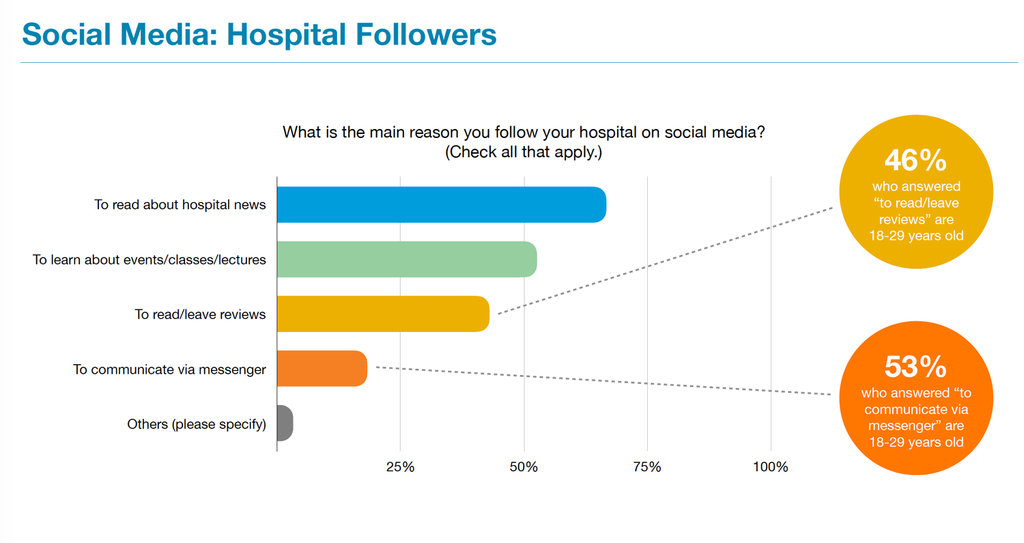
The top two reasons 18-29-year-old respondents follow their hospitals on social media are (1) to communicate via messenger, and (2) to read/leave reviews.
Speak with a Unified Voice
To understand consumer preferences, a community manager who produces good content and engages with other social media feeds is a must, and so is consistent messaging. “You need to appear as one entity,” advises Herriman. “It’s not uncommon for a large hospital or private practice groups to lack a unified voice. But this is exactly what’s needed to engage with your audience effectively.”
Examples of hospitals doing it right? Check out the Mayo Clinic, Cedars-Sinai, and the Mount Sinai Health System.
“Young people are your followers. They want to leave reviews and post on chat. They want their voices to be heard and they want the most engagement.”
Amanda Herriman
Wax Custom CommunicationsImportance of Online Reviews
More than 75 percent of respondents said they visit review sites such as Yelp, TripAdvisor, and others to make decisions about purchases, travel, and restaurants. Less than 50 percent use review sites to research hospitals. So how important are online reviews for consumers deciding which hospital to choose?
It turns out that other people’s experiences matter. Sixty-three percent of respondents answered that negative online reviews would influence their decision, and 57 percent answered that they have a negative perception of a hospital with outdated information.
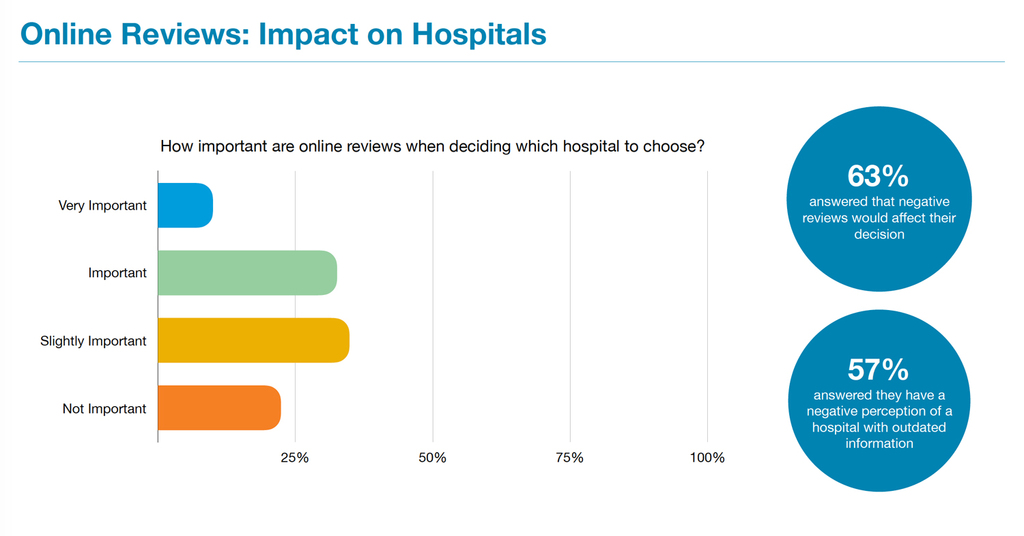
The research makes a strong case for the importance of managing your reputation and keeping your site information up to date.
Fifty-one percent of those who used review sites use Yelp to research hospitals, followed by Google My Business, the Better Business Bureau, Healthgrades, Facebook, and others.

Craig Fairfield, managing director, Wax Custom Communications
“Make it really easy for people to post positive reviews and push that out right away. When it comes to negative reviews, play offensively. You have to be ready to respond,” says Fairfield, Herriman’s co-presenter. “For example, if you get negative feedback or a one- or two-star online review, you need an organized approach, a methodology or social listening tool, and reply to people who are unhappy before they blow up on social media. There has to be two-way communication. If people leave comments and don’t get a response, they’ll likely consider it rude.”
Benchmarking with the PowerScore
A new descriptive statistic Wax has developed called PowerScore helps marketers determine their rank against the competition. The development of the PowerScore preceded Wax’s national study but aligns with it perfectly, allowing marketers to compare themselves across the board in terms of their content, engagement, experience, and social reach, and track their progress over time.
“The algorithm works using publicly available data, making it quick to calculate and easy for anyone to inquire about it,” says Herriman.
Powering Up Your Brand
To make the most impact with your social media presence, be proactive and keep abreast of current trends.
“Take a powerhouse approach,” advises Fairfield. “To increase your visibility, you need to ‘like’ and participate in other people’s feeds. Use Facebook effectively with the tools available such as Facebook Business Manager, which allows you to manage your assets such as your Pages and ad accounts. Have a consistent voice, stick to a single domain, play offensively when it comes to patient reviews, and check your links on a regular basis.”
Finally, be ready to respond and engage with your audience. The cohort of digitally savvy 18–29-year-olds demands no less.
Marlene Kurban is a business development consultant and freelance writer with more than 20 years of experience in the behavioral health care field.